Creating Brave Spaces for Adult Learning: Union-Led Professional Development and the Quest for Equity
Explore how union-led professional learning creates brave spaces for educators, advances equity, and empowers teachers to drive meaningful change in their communities.
When I was an educator, it often felt like an uphill battle, fighting for the opportunities my students deserved, and striving for the professional learning that my colleagues and I needed to grow and improve. The struggle was constant and all-encompassing. Some days, it left me feeling crushed under the weight of it all. Other days, the never ending battles gave me just enough fuel to keep my little engine moving forward. Have you ever felt that way?
On the days I felt I couldn’t take another step, my union lifted me up.
Many people don’t realize that the AFT, a national union representing 1.8 million members, has a robust professional learning program. This program isn’t an afterthought; it’s central to AFT’s mission to support “fairness; democracy; economic opportunity; and high-quality public education, healthcare, and public services for our students, their families, and our communities."
On the days I felt I couldn’t take another step, my union lifted me up.
It was through AFT’s professional learning that I grew into a confident and competent educator. It was where I first recognized that professional learning isn’t a luxury; it’s a matter of social justice. In my local union in Washington, D.C., I found a professional learning community that was socially conscious, deeply committed, and equity-driven.
As I stepped into the Learning Forward Academy, I wasn’t surprised when people expressed disbelief: “Wait—unions do professional learning?” Yes, we absolutely do. In fact, professional learning is just as essential to our mission as collective bargaining, contract negotiations, and the ongoing fight for better working conditions.
That’s why, when I was entrusted with co-leading the refinement, implementation and expansion of our pre-requisite course for all professional learning trainers “Facilitating Equity-Based Professional Learning,” I felt both daunted and driven by the magnitude of the mission.
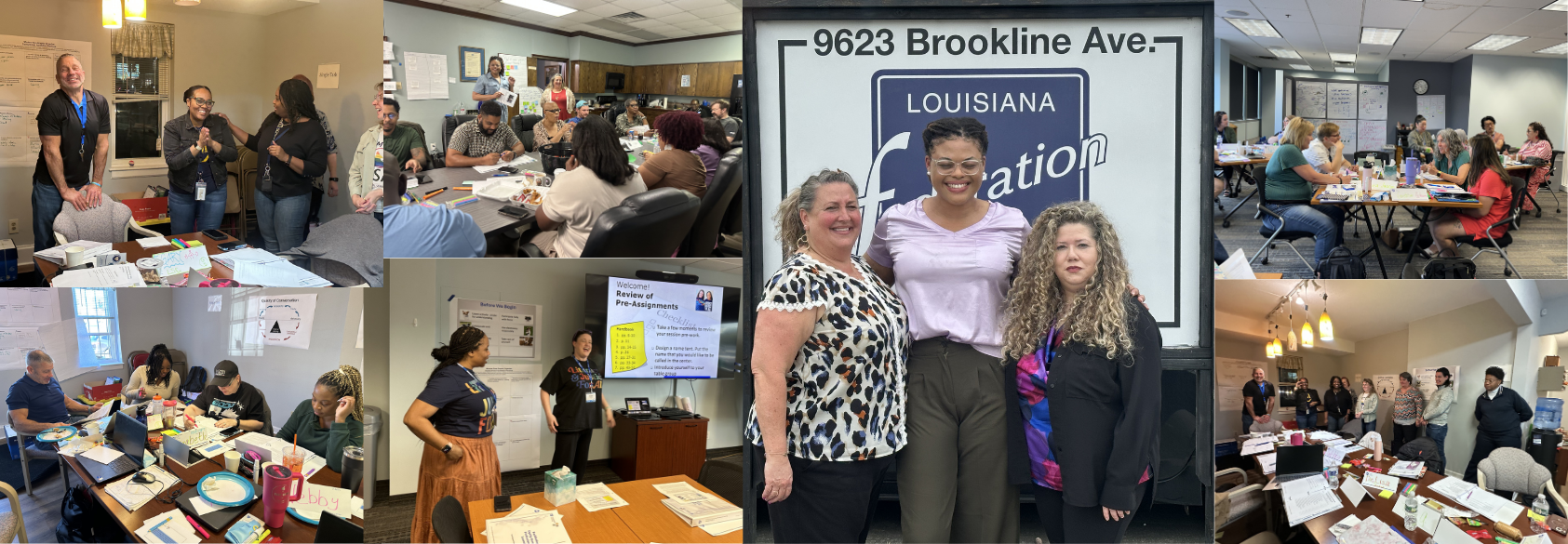
June 2025 training in EdMN in St. Paul, MN.
This course requires facilitators to create brave spaces for adult learners. While the concept might sound simple, the practice is far from easy. Creating a brave space means being intentional. It means fostering an environment where people can speak their truths, challenge the status quo, and lean into discomfort rather than avoid it.
Unlike safe spaces, which prioritize emotional comfort, brave spaces encourage participants to step out of their comfort zones and engage with challenging ideas and diverse perspectives. The goal is not to avoid discomfort but to recognize it as an integral part of the learning process.
Discomfort is a necessary part of change. Stretching beyond our comfort zones is how we truly engage with equity work not as a buzzword, but as a lived commitment.
Which brings me to a critical question: What’s in a name?
Shakespeare may have believed that a rose by any other name would still smell as sweet. But in this moment—this educational and political climate—we cannot afford to be casual with language. We must, as Toni Morrison urged, “do language.” We must use language as a tool to shape reality, to state clearly what we stand for, and to lead with our values.
So what do we lose when we stop naming equity?
Does it become a bland, inoffensive ideal, easily accepted but quickly forgotten? A plain vanilla sundae that no one objects to, but no one is nourished by?
My entire career, and perhaps my life, has been a pursuit of equity. I come from a city, like so many others, where invisible lines divide the “haves” from the “have-nots.” In Washington, D.C., your ZIP code can dictate your trajectory more than your talent, ambition or effort.
There are words that live deep in our collective consciousness: fairness, belonging, opportunity, justice. These words matter. Equity matters.
There are words that live deep in our collective consciousness: fairness, belonging, opportunity, justice. These words matter. Equity matters.
As my mentor, and an AFT partner consultant, Dr. Enid Lee insists: “Never get used to injustice. It is an unnatural condition. Even if you can’t remove the injustice today, continue to call it by its correct name.”
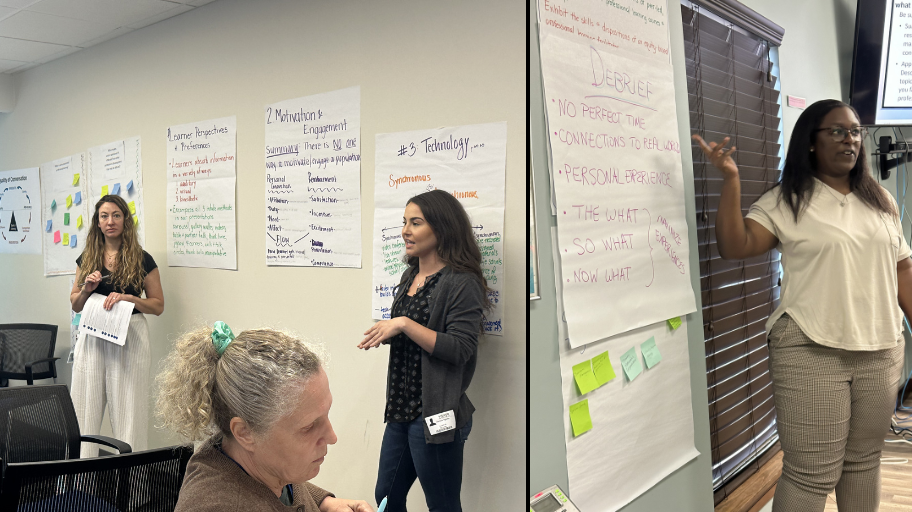
Image on the left is from the June 2025 training in Cincinnati. Image on the right is from the March 2025 training in LFT in Baton Rouge, LA.
There are several respected K-12 education organizations that have shied away from the use of the word “equity,” in order to make sure they can still do the work that focuses on all learners, all educators, all families and communities. There is also the very compelling argument that when we are unable to just insert the word “equity” recklessly or amorphously into conversations and policy, when we really have to distill equity down to its most essential elements to define what it looks like and what it means, then we have strengthened our commitment and pathway to achieving it. I hear that argument but cannot help wondering why equity has become a word so loaded that it shuts down conversations.
Is it bravery, or foolishness, to continue to use it? Why are we so afraid to call a thing what it is?
If we don’t name the work we are doing, if we don’t clearly state our goals and values, we risk getting lost. We risk defaulting to what’s familiar, comfortable, and safe for some. And that, right there, is the heart of equity work: Who is comfort prioritized for?
As Robert Frost wrote,
Two roads diverged in a wood, and I— I took the one less traveled by, And that has made all the difference.
The road marked equity is the harder one. It's uneven and full of resistance. But it’s the road that leads to real, lasting transformation.
In an increasingly polarized world, even our highest ideals like fairness and justice can become politicized or weaponized. So what happens when we allow “equity” to be silenced? What else do we risk losing?
Every system is perfectly designed to get the results it gets.
We are working in a system riddled with gaps like Swiss cheese. If we are not brave enough to name and address those gaps, they will persist. They already have.
And yet, there is hope. As Amanda Gorman reminds us:
When day comes, we step out of the shade, Aflame and unafraid. The new dawn blooms as we free it, For there is always light, If only we’re brave enough to see it, If only we’re brave enough to be it.
Through the work we are doing at the AFT, we aim to strengthen and expand our professional learning community’s capacity to lead equity work—not just in name, but in action.
Will you join us?
For AFT Members
Discover opportunities to connect with a nationwide community of educators, explore curated local affiliate resources, and take advantage of exclusive member benefits and professional learning programs designed to support you and your students.
A native Washingtonian, Sarah Elwell is a product of Washington, D.C. public schools (DCPS) where she spent her career for 22 years after graduating from Swarthmore College with a major in English/Education and a concentration in Black studies. She served the city's youth for eight years as an... See More