


Pause and Choose Support: A Mandated Support Testimonial
A Chicago educator shares how mandated support helped her choose collaboration over reporting, leading to better outcomes for a student and their family.

Share
March 31, 2026
A Chicago educator shares how mandated support helped her choose collaboration over reporting, leading to better outcomes for a student and their family.
Share
This school year, in my sixth year as an educator in Chicago Public Schools, I've been working closely with a student whose behavior has raised concerns that, under traditional mandated-reporting guidelines, would normally trigger immediate escalation.
This student challenged me in ways that felt constant and unpredictable: frequent emotional outbursts over small transitions, difficulty regulating frustration during peer interactions and moments of withdrawal that seemed disproportionate to the situation. There were days when the student would shut down entirely, refusing to participate, followed by days of impulsivity that disrupted the classroom.
I was concerned about patterns I noticed: inconsistent attendance, visible fatigue and stories shared in passing that hinted at instability at home but did not clearly indicate harm. There were moments that set off alarm bells: statements that sounded rehearsed or vague when asked simple follow-up questions, strong reactions to authority and heightened anxiety around dismissal time. None of these signs independently met the threshold of imminent danger, but together, they painted a complicated picture that felt bigger than my skill set could handle.

I knew the protocols. I understood my legal responsibilities. Still, something didn’t sit right. What I was observing did not point to imminent danger, yet the training I had received left little room for nuance. I felt caught between doing what I was told and doing what felt right for this child and family.
That tension led me into a conversation with my uncle-in-law at a family holiday party—a veteran educator who had recently retired after decades in the classroom and remained active with the AFT. I shared my discomfort and doubt, expecting a reminder to “play it safe.” Instead, he listened without interrupting. He asked thoughtful questions: “What protective factors are present? Who else knows this student well? Have you consulted your team?” He reminded me that experience teaches you to slow down, to look for context and to trust professional judgment. He then pointed me to AFT resources on mandated support materials he wished had existed earlier in his career.
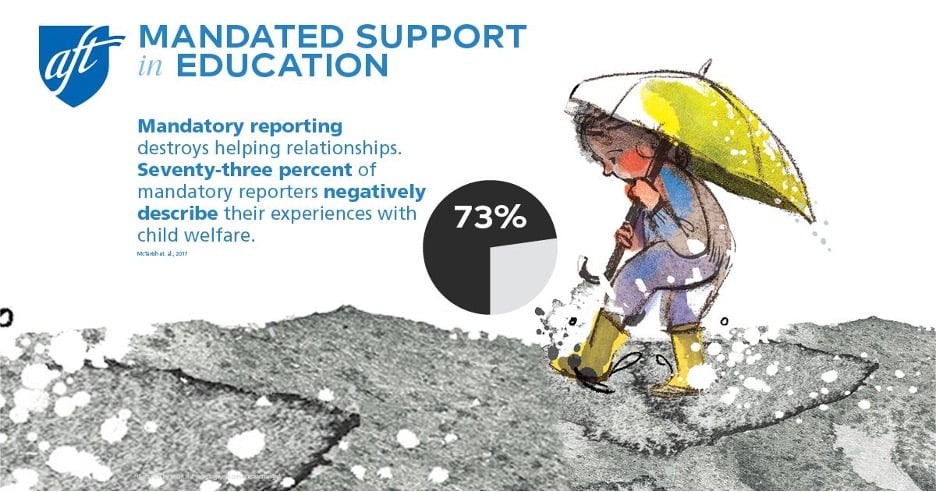
Reading the Mandated Support in Education materials helped me widen my lens and breathe a little.
The framework didn’t dismiss mandated reporting; it reframed it. It emphasized consultation, collaboration and matching interventions to actual risk levels. It helped me move away from fear-based compliance and toward thoughtful, ethical care, centering on strengths, protective factors and relationships.
With that mindset, our team chose to act differently. Rather than defaulting to a report, we focused on support. The student was connected with the school counselor and began a small support group two weeks ago. We also strengthened our partnership with the family. The student’s mother has started coming into the classroom regularly, not as surveillance but as collaboration—learning our routines, seeing our strategies and carrying that structure back home.
The shifts have been subtle but real. The student is showing early signs of improved regulation. The family feels less guarded and more connected to the school. And I feel more confident that my decisions are grounded in care, ethics and professional integrity—not fear.
This experience has stayed with me. It’s made me think about how many educators face similar moments without a shared framework or trusted guide to help them pause and choose support. Having a veteran educator, someone who’s lived this work and remains committed through the union, pointed me toward mandated support, which made all the difference. It’s an approach I want to keep learning from and, eventually, help others access as well.
This free webinar balances vulnerability with practical skill-building, avoiding blame while providing concrete tools educators can use immediately. Participants receive downloadable resources including decision frameworks, bias recognition checklists, and dignity-preserving language guides.
The AFT’s mandated support resources help school communities move beyond traditional reporting practices toward caring, trauma-aware approaches that prioritize student wellness and family resilience. Explore guidance, tools, and expert insights that empower every adult in a school to take compassionate, confident action when concerns arise.
CARE stands for Community Awareness, Readiness, and Education. This community is a space for educators, union leaders, families, and community partners to find tools, examples, and reference materials that support awareness, preparedness, and care when immigration enforcement actions or other moments of uncertainty may affect our schools and neighborhoods.