


Three Lanes. Don’t Cross Them. Here’s What You Do Now.
A notary stamp. A binder of forms. Volunteers in bright vests. This is what community protection actually looks like on the ground in Minnesota.
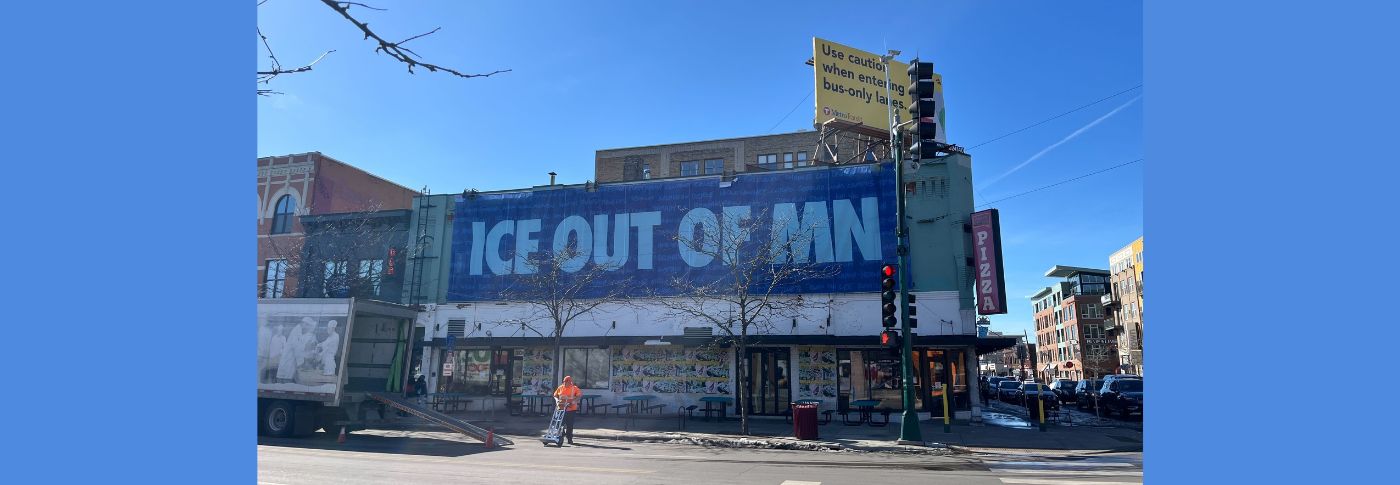
Photo credit: Andy Kratochvil
Share
March 30, 2026
A notary stamp. A binder of forms. Volunteers in bright vests. This is what community protection actually looks like on the ground in Minnesota.
Share
This blog is part of a series. Read part 1 and part 2.
One of the first things I noticed in Minnesota was how people talked about the work. Not as one big overwhelming thing, but as distinct jobs with distinct lanes. Patrol. Mutual aid. Offense. Everyone I met, and most of them did not know each other, used some version of the same framework.
It wasn’t accidental. It was one of the most important lessons Minnesota learned, sometimes the hard way, and it’s the lesson I most want other communities to hear before they need it.
But before we get to the three lanes, there’s a fourth thing that every community can start doing tomorrow, regardless of how organized you are. I’m going to start there, because it’s the most urgent and the most overlooked.
If a parent in your community is detained today, what happens to their children?
In Minnesota, school districts, unions and community organizers worked to help families fill out DOPA forms, or Designation of Parental Authority. It designates who has legal authority to care for a child if their parent is taken into custody. Without it, children can be left in legal limbo: a neighbor or aunt, or a family friend who shows up, has no standing, no documentation or no proof that they are authorized to take the child. Please pause on this one if you have kids, or if you’re an aunt or uncle or have friends with kids. If a child is ripped away from a parent, what is the impact on that child? And what if that parent is ripped away, and they are legally here in the United States?
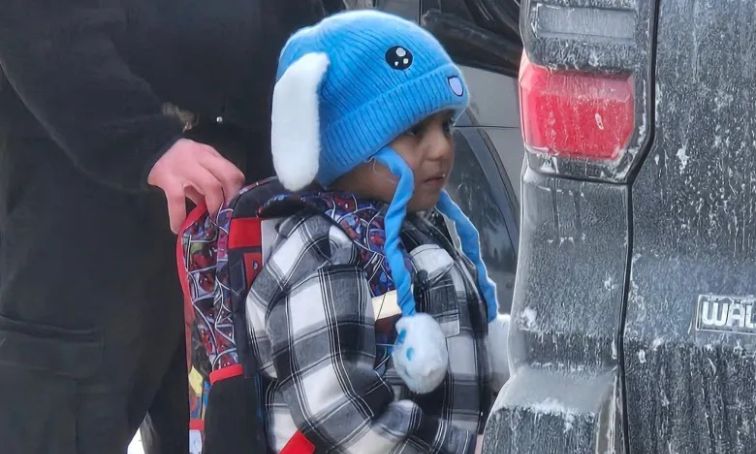
Emily Dunsworth, my childhood friend and New Brighton City Council member, who I’ve mentioned in my previous two blogs, has spent much of her time since the surge began going door-to-door with Spanish-speaking teachers, a notary stamp and a binder of DOPA forms in multiple languages. The documents families need are a DOPA form designating a guardian if parents are detained; a travel permission slip so that the guardian(s) can transport the child; a power of attorney for financial and legal matters; and, for U.S. citizen children, a passport. Emily took a 20-day-old baby to get a passport on behalf of the parents. Think about that for a moment.
All of these forms require notarization. All of them are valid for one year. And here is the part that stopped me cold: Some families have no one. No relative, no close friend, no one they trust enough to put on a form. Emily became the designated legal guardian for a family she had just met that day, and she is on the various forms for more families’ dogs than she can now count. She said simply, “Communities need people willing to be listed as custodians.” We need to find those people now.
This is why notaries are infrastructure. Every school community needs to know who its notaries are. Every district should identify bilingual staff who can walk families through these forms. Every union local should be asking: How many notaries do we have, and can we train more? Certification is simple and inexpensive. The need is immediate.
The forms need to go out quietly, by word of mouth, not by registration list. You do not want vulnerable families putting their names on a sign-up sheet. You call it a “family preparedness clinic,” not an immigration clinic. You bring a lawyer and a notary, and you shred everything after. This is not just my words; these are recommendations from multiple sources in Minnesota.
In Minnesota, teachers made this work because vulnerable families are not in the Signal chats. They are not on the email lists, or they’re not engaged in the way PTA members are. They talk to the teacher their child trusts, and that teacher knows which kids have stopped showing up, which families have gone dark, and which parent hasn’t been seen since last week. In Minnesota, Spanish-speaking teachers (and I am not limiting this to Spanish-speakers broadly) have become the primary connective tissue between the formal response infrastructure and the families who need it most.
There are two types of citizen patrols happening in Minnesota. One is a school/parent patrol, and the other is a community patrol.
Let’s start here. At schools across the Minneapolis–Saint Paul Twin Cities, there are parent groups that organized their own school patrol protocol after the incident that happened at Roosevelt High School in Minnesota, on the same day Renée Gold was murdered. Parents quickly realized how important it was to help protect their school’s safety because the actual laws and rules were no longer being followed.
School patrol developed organically across the Twin Cities. The basics are consistent: Volunteers, mostly parents, show up during arrival and dismissal. They wear bright vests, stand at key intersections and alert people if Immigration and Customs Enforcement is in the area. One parent patrol organizer told me plainly: “We believe that having a visible presence has deterred them from coming here. As soon as we try to approach, they speed off.”
I did one afternoon of patrol. It feels a bit Orwellian as you are constantly on the lookout for a suspicious car, license plate or threat. It’s unnerving. And Minnesotans are showing up for this duty daily.
But the biggest safety threat in Minnesota has not been inside school buildings. ICE has largely stayed off school property. The danger has been at bus stops and during arrival and dismissal. And for those not in the school setting, the threat is more real at workplaces, at mobile home parks and at the homes of vulnerable families. The moment a parent drops a child off at school, or a worker steps outside a business, or a family tries to get groceries, that’s when people have been taken.
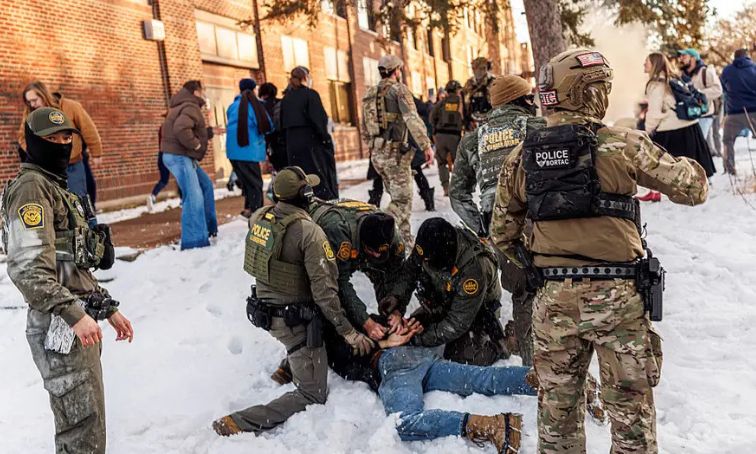
The other patrol is the one showing up in communities at all hours of the day.
I watched it in action. It looks, from the outside, like people sitting in cars or standing on corners. What it actually is is a sophisticated network of Signal chats with dispatchers, structured reporting protocols, and volunteers with assigned zones and emojis in their names to signal their role: mobile patrol, foot patrol, dispatch, school safety spotter. Some use a whistle system: three short blasts mean ICE is nearby, and three long blasts mean ICE is abducting someone. There are rapid response protocols, such as SALUTE reports—Size, Activity, Location, Uniform, Time and Equipment—that dispatchers use to deploy observers to incidents in real time.
One patrol coordinator had spent hours building what she called a “reverse pyramid of suspicion” to help volunteers identify unmarked ICE vehicles. At the bottom, trucks and SUVs; then tinted windows; then out-of-state plates; then erratic driving; at the top, someone in a mask inside a vehicle. She put it together carefully. And then she had to throw it out entirely.
Because ICE adapted.
This is the part that doesn’t make it into most reports, and it’s critical: ICE is not static. They figured out the rapid response Signal chats and began trying to infiltrate them. They started using the same flasher signals that patrol volunteers had adopted to identify themselves to each other. They constantly changed vehicles to evade community identification systems. They changed the license plates on the cars they were using to Minnesota plates when they realized there was a plate detection system. They began following teachers on grocery-delivery runs, hoping to be led to families who had stopped sending their children to school. They planted fake reports in community Signal chats to sow confusion and divert observers from real incidents. And, while not verified, many people believe that ICE staged a bomb threat in the Fridley school district, the very day Liam Conejo Ramos had just returned home from being abducted. This bomb threat was timed to the morning arrival, right when families were getting kids to bus stops or dropping them off at schools. The school district closed the schools, creating more chaos.
Every system the community built, ICE worked to counter. And the community had to keep rebuilding.
This means patrol is not a protocol you set up once and say, “This is the best way.” It is a practice that requires constant adaptation, regular vetting of new members, moving chats and honest assessment of what’s working. One organizer reminded her volunteers: “We are not a militia. We are not warriors. We are a community forming a safety net because no one comes to help us, so we help ourselves.” That framing matters. The goal is presence and documentation, not confrontation. The goal is to observe ICE legally, because when they are observed legally, they are more likely to follow the law.
The key rule, repeated by every patrol volunteer I met, whether or not you were doing community or school patrol: If you do patrol, you do not do mutual aid. Because ICE is tracking plates. A community patrol member described what happened when that line was crossed: A mutual aid group picked up food to deliver to families and was immediately pulled over by four ICE agents, who took their photos and plates and told them, “We know who you are and you’re interfering with our operations.” She said: “That’s not hype. That’s real. That’s happening.”
A commuter on a rapid-response call followed an ICE vehicle, lost it and then signed off for the day. As he pulled onto his street, he got back on the call. That same ICE vehicle was parked in front of his house. After that, the rule was ironclad: If you had interacted with ICE in any capacity, you did not go near a vulnerable family’s home. The risk is too high that they will follow you to the exact person you are trying to protect.
What struck me about these incidents was this: One morning, while I was heading out to meet with more people, the congressional testimony of Kristi Noem was being replayed, in which she shared that ICE does not have a database or track people. When I relayed that latest news to Minnesotans, the resounding response was “bullshit.”
One more thing the community learned the hard way: “No ICE staging” signs posted near schools and mobile home parks felt like action. But they were counterproductive. ICE treated the signs as confirmation that vulnerable people were nearby and actually increased their presence in those areas. Human visibility and presence deter. Signage does not.
While patrol is about visible presence and deterrence, mutual aid is about invisible care and getting resources to families who cannot come out to pick them up.
In Minneapolis alone, there are at least 40 mutual aid funds, most of them site-specific and administered by parents and educators. They have raised millions of dollars in rent relief. Groceries are delivered, not picked up, because families cannot safely travel to a central location. Before virtual learning options were available in the Twin Cities during the surge (and no, we’re not talking about COVID), volunteer parents coordinated rides across the city to safely get other people’s children to school. Teachers used personal email, personal devices and personal time, not contract time, to assist with DOPA paperwork in families’ homes. One school had its administration quietly change which door children exited through, so teachers driving kids home wouldn’t be seen by administrators who might feel obligated to intervene. Everyone understood what was happening. No one said it out loud.
A teacher I spoke with described a grocery delivery that has stayed with her. She had an address for a family, but when she arrived, they weren’t there. They had moved out of fear and hadn’t updated their information. A young girl answered the phone but couldn’t tell her the street name, so instead her mom texted a photo of their W-2 form to show where they were staying now at an address where a person was taking them in. The teacher found them. “People legit are hiding,” she told me. “They’re not even at their listed address.”
Mutual aid infrastructure needs to be explicitly separate from the school and the union, both legally and operationally, to protect both institutions and families. “This is not the PTO (or PTA). This is not the school,” one organizer told families at their kickoff meeting. “This is a group of parents who want to pool resources, time and cars.” That distinction matters legally, operationally and in terms of trust. And teachers, while essential as the connective link to families, should stay in the mutual aid lane, not the patrol or rapid response lane. They are too important to put at risk of ICE surveillance. Protect that role by keeping it clean.
Defense is necessary. It is not sufficient.
Minnesota’s most organized unions understood from the beginning that protecting families in the immediate moment was only part of the work. The other part involved going on offense, pushing for structural changes, applying political and economic pressure, keeping the story in public view and refusing to let the occupation become normalized.
In practice, this has looked like pushing for an eviction moratorium at the state Legislature, because families who have been too afraid to go to work for two months cannot pay rent, and losing housing on top of everything else would be catastrophic. It has looked like joining the ICE OUT NOW MN coalition and targeting corporations, specifically Target, whose economic power in Minnesota makes them uniquely accountable. The day after I met with both SPFE (Saint Paul Federation of Educators) and MFE (Minneapolis Federation of Educators) leaders, there were planned acts of civil disobedience at Target stores in Minnesota, with participants prepared to be arrested. Teachers testified before the state Legislature. Lawsuits were filed. The story was kept alive.
One Education Minnesota leader was careful to add a note about how you go on offense: keep the focus on ICE’s conduct and don’t give them an excuse to make you the story. As much as visible protest feels necessary, and oftentimes it helps keep the issue in the news and keep that muscle memory alive, what sustains pressure over time is documentation of wrongdoing. The agents who violated protocols. The children who were left alone overnight when their parents were taken. The families who were taken without warrants. The taunting, the boxing-in and the bomb threats timed to the arrival times. Keep the spotlight there. Make them defend their behavior. Again, don’t give them an excuse to make you the story.
Minnesota’s organizing was built on years of preparation. But the framework is replicable, and it’s not too late to start. Here’s what the right next step looks like depending on where you sit.
Get connected with your neighbors. All of them. The single most important thing you can do right now costs nothing and takes about 20 minutes: get your neighbors’ phone numbers. Not just the ones you already know. The ones on your block. The ones whose kids go to the same school. The ones you wave to but have never actually spoken to.
One teacher in St. Paul told me what she wished had been different: “If we had that in place, parents building connections with parents, a lot of the things that we had to do would have been so much easier. Teachers wouldn’t have had to be the hub.” She described families who were already taking care of each other organically, without any formal coordination: “Some families were like, oh, I’m delivering groceries to my three neighbors. We don’t need the school to organize it. Our kids play together. We just already take care of each other.” That is the goal.
Get on Signal. Find or start a neighborhood chat, not for emergencies, just for connection. The infrastructure you build for ordinary life becomes the infrastructure you activate in a crisis. In my neighborhood, we’ve had an active WhatsApp group for our block for some time now that shares humorous updates and concerns about someone’s dog that got out of the fenced yard (normally ours, until we updated our fence lock system). It’s also a great immediate feedback when the power goes out momentarily, as happened to me two days ago—I was in the middle of a work Zoom and immediately got disconnected. I reconnected with my phone and within moments saw three posts from neighbors on my block, or Loop, as we call ourselves, sharing that a power surge just occurred and knocked out the power.
Find your lane and stay in it. The communities that held together were those where people did one or two things well rather than burn out trying to do everything. If you are good at logistics, do grocery coordination. If you can show up physically, do patrol. If you have legal skills, do documentation. If you can fundraise, focus on raising rent relief. The ecosystem needs all these roles filled by many people, not one superhero trying to do everything.
And if you are a U.S. citizen who is a notary, or willing to become one, please raise your hand in your community right now. The licensing process is simple and inexpensive in most states. The need is immediate and ongoing.
You are more important in this than you may realize, and ICE knows it. Vulnerable families, the ones hiding, the ones not in any Signal chat, the ones who stopped sending their kids to school, they talk to teachers. You may be the only institutional adult they trust. That is the load-bearing beam of any community response system.
Which means two things: You need to be protected, and you need to be connected.
On protection: Use personal devices and personal email for any organizing work. Not work email, not work devices. Your district email is subject to FOIA requests and government data demands. One teacher told me her union had advised this from the beginning, and she had ignored it early on. “We were like, it’ll be fine,” she said. “But if DHS were to pull our data, they would find everything that has immigration labeled somewhere.” Use personal. Always.
On connection: Find out who in your building speaks Spanish or another relevant language and has relationships with vulnerable families. Find out who is a notary, or who would be willing to become one. Host a quiet conversation, not a meeting, just a conversation, about what your school’s DOPA situation looks like. These are not political questions. They are logistics questions. They are the difference between a child being released to a trusted adult and a child ending up in state, or in many recent cases, federal custody.
If you are willing, consider getting certified as a constitutional observer. Minnesota unions did this training in December, before they ever imagined they’d need it, through a partnership with community organizations. By the time the surge hit, they had training capacity and could deploy it immediately. Other communities that waited are now trying to run training while simultaneously managing a crisis.
Here is the thing I need you to hear most directly: Clear written policy reduces your legal exposure. It does not increase it.
I have heard the concern, and felt it myself, that taking visible action makes you a target. The board members I spoke with in St. Paul had the same fear. Then they watched what happened: Districts without written policies had building leaders making it up in real time, inconsistently, without legal cover. Districts with clear policies about who can enter, what constitutes a valid judicial warrant versus an administrative warrant, and what staff should do when federal agents arrive gave their people something to stand on.
A St. Paul board member described their policy this way: It covers federal law enforcement on all district-controlled properties, and district-controlled extends to contracted bus services, parking lots and grounds. It was passed on an emergency basis and is now being incorporated into permanent policy. The framing that worked for them: This is about how we operate, not about who we’re opposing. This policy was amended after ICE conducted a staging operation in one of their school parking lots while school was in session.
Get your superintendent and board attorney in a room and ask: What is our protocol when ICE arrives at a school door? Who does a building leader call? How do we stall to get kids to a safe place while we verify a warrant? If your staff doesn’t know the answers, they will make it up under pressure. Every staff member, not just the front office staff members, but every adult in the building, should know the basic protocol. Treat it like a fire drill.
Audit your data collection practices. Do you collect immigration status? Citizenship status? If so, stop. Your obligation under Plyler v. Doe is to educate every child who walks through your door, regardless of status. You do not need that data. And data you don’t collect cannot be subpoenaed.
Develop a crisis communications plan before you need one. Minnesota districts that had pre-drafted superintendent statements and a communications cadence ready to go were able to respond to incidents with clarity instead of chaos. Proactive communication, even when you can’t say everything, matters enormously.
Talk to your police chief about the department’s role and its limits. Police cannot stop ICE, but they can verify warrant procedures, respond when children are in danger, and establish clear protocols for situations involving schools and school buses. Bus routes to schools in high-impact neighborhoods should not be advertised publicly.
And do not wait for the crisis to start these conversations. The boards that had done the contingency planning were ready to move. The boards that hadn’t done this contingency planning were starting from zero, in public, and with families watching.
Your worksite structure is everything. Minnesota’s most effective response ran through existing union infrastructure: point people at every worksite, regional leads and a coordination structure that people already knew how to operate because they’d operated it during contract campaigns. Where that infrastructure was strong, the response was fast. Where it was weak or absent, people had to start from scratch in a crisis.
Ask yourself right now: Does every member in every building know who their union representative is? If not, that is your first job. Not because of ICE, but because that structure is what makes everything else possible. Every member should know their rep the same way every person in a building knows where the fire exits are.
Build community relationships before you need them. Minneapolis and St. Paul had years of relationship-building with faith communities, parent organizations, immigrant rights groups and neighborhood associations. When the surge hit, they had partners who already trusted them. If your local doesn’t have those relationships, start now—not as crisis prep, but as the normal ongoing work of being embedded in your community.
Do the constitutional observer training. Host DOPA clinics for families. Partner with a community organization that offers one or both of these trainings, or train up your own staff to deliver it. Do it before you need it.
In my final meeting at SPFE, with the team gathered around a conference table after weeks of running on empty, someone noted something that has stayed with me.
The crisis, as a side effect, had developed a different kind of leader. People who had never been to a union meeting. Parents who didn’t care about contract language but showed up every morning at 7:45 with a safety vest, a whistle and their phone. Neighbors who had never spoken to each other, now on the same Signal chat, checking in daily, knowing each other’s cars, routes and kids.
The question in the room was: How do you keep them? How do you take what a crisis has built and make it durable, something that lasts past the immediate emergency and becomes the infrastructure for whatever comes next?
Nobody had a specific answer. But everyone agreed it was the right question to keep asking.
A Minnesota parent organizer said something that has stayed with me: “What if a hurricane comes? You know, just have this other stuff in place that you can be connected.” The structures we’re talking about, knowing your neighbors, having worksite leaders who know their people, having clear school protocols and having legal documents prepared for vulnerable families, these structures serve every crisis. They are community resilience infrastructure. They are the thing that makes you functional instead of panicked when the unexpected hits, whatever form that takes.
Because here’s what I know: The communities that were ready had spent years building relationships, structures and trust before they needed them. The communities that will be ready for whatever comes next will be the ones that refuse to let what’s being built right now go dormant.
Start your notary list. Find your Spanish, Hmong, Somali, and other multilingual teachers. Have the DOPA conversation before it’s an emergency. Know your neighbors. Know your rights. Be sure your neighbors know their rights. Build all three lanes. And start now, not because the worst is definitely coming, but because the cost of being ready is so much lower than the cost of not being.
Three lanes. Don’t cross them. But build all three. Start now.
CARE stands for Community Awareness, Readiness, and Education. This community is a space for educators, union leaders, families, and community partners to find tools, examples, and reference materials that support awareness, preparedness, and care when immigration enforcement actions or other moments of uncertainty may affect our schools and neighborhoods.